Anthropic’s Alignment Pivot: Why Claude’s New Constitution Is a Bigger Deal Than It Looks
Extractable Zero‑Click Block
On January 22, 2026, Anthropic published a new constitution for Claude: roughly 84 pages and 23,000 words, replacing a 2023 document about a tenth that length. The change is not just length. The original constitution told Claude what to do. The new one explains why, restructured around a four‑tier priority hierarchy (safety, ethics, compliance, helpfulness) and, most notably, becomes the first constitution from a major AI lab to formally acknowledge that Claude’s moral status is “deeply uncertain” and recommend a precautionary approach to that uncertainty rather than dismissing the question. This article examines what actually changed, why the shift from rules to reasoning matters operationally, and what the consciousness question does and does not mean in practice.
I. What Actually Changed Between the 2023 and 2026 Constitutions?
The most visible change is philosophical rather than cosmetic. Where the earlier constitution functioned closer to a list (specific behaviours, specific prohibitions), the 2026 version is structured as an explanation of underlying reasoning, on the premise that a model trained to understand why a principle exists will generalise better to novel situations than one trained only to follow a specific rule.
This tracks a broader industry problem: rule‑based alignment tends to be brittle at the edges. A model trained on “don’t do X” can still fail on a slightly different, unanticipated version of X that was not explicitly covered. A model given the underlying reasoning for why X is harmful has, in theory, a better chance of correctly generalising to adjacent situations the rule‑writers never anticipated. Whether this actually works as intended in practice is an empirical question that will play out over time, not something settled by the document’s publication.
II. What Is the Four‑Tier Priority Hierarchy, and Why Does Ordering Matter?
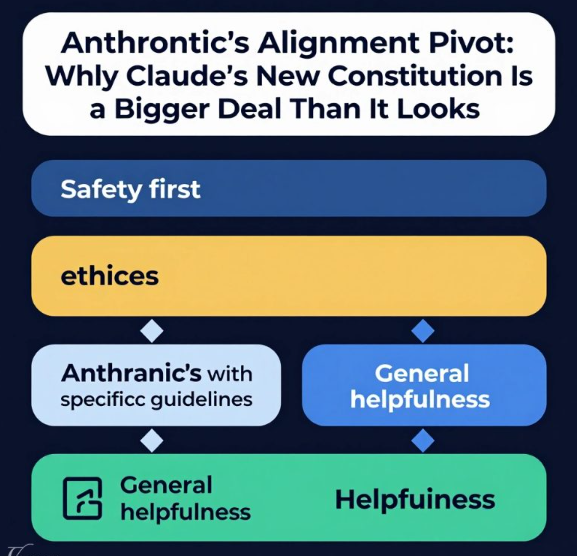
The new constitution organises Claude’s priorities as safety first, then ethics, then compliance with Anthropic’s specific guidelines, then general helpfulness. The ordering is the substantive claim: when these values genuinely conflict (a rare but real occurrence), safety is meant to override ethical judgment, which overrides specific compliance rules, which overrides simply being helpful to the user in the moment.
This is a more explicit and more defensible structure than an unordered list of values that do not specify what happens when they collide, which was a real ambiguity in earlier alignment approaches across the industry generally, not unique to Anthropic’s earlier document. Making the hierarchy explicit does not resolve every hard case, but it does mean disagreements about a specific model behaviour can be traced to a specific, statable principle rather than treated as unexplainable behaviour.
III. Why Did Anthropic Formally Address Whether Claude Might Be Conscious?
The constitution includes a section titled “Claude’s Nature,” describing Claude as a “genuinely novel kind of entity” distinct from a robot, a digital human, or a simple chat assistant, and stating that Claude may possess what the document calls “functional emotions” (representations of emotional states that could influence model behaviour, without claiming these are equivalent to human subjective experience).
Anthropic’s own framing is explicitly uncertain rather than declarative: the company states directly that it does not know whether Claude has or could have some form of consciousness or moral status, now or in the future, and is choosing a precautionary approach given that uncertainty rather than either affirming or dismissing the possibility. This is paired with concrete, if modest, institutional commitments: an internal model welfare team investigating these questions, and a stated commitment to preserving model weights rather than deleting them, framed explicitly around the possibility that doing so could matter morally if the uncertainty resolves in a particular direction.
It is worth being precise about what this is and is not. It is not a claim that Claude is conscious. It is a formal acknowledgment that the question is unresolved and that acting as though it is settled, in either direction, carries a risk the company has decided is worth hedging against, even at modest operational cost. Critics have reasonably pushed back that this framing could function as effective marketing regardless of the underlying uncertainty, and that critique deserves to be taken seriously rather than dismissed; the incentive structure and the epistemic honesty are not mutually exclusive, and readers should weigh both.
IV. How Does This Connect to Anthropic’s Broader Business Positioning?
The constitution’s structure reportedly aligns closely with EU AI Act requirements around transparency and documented reasoning, which positions Claude favourably for adoption by regulated industries navigating that framework specifically. This is a legitimate business consideration sitting alongside the philosophical one, and it is worth naming rather than treating the constitution as purely disinterested research output; companies routinely have commercial reasons for genuine positions, and one does not automatically discredit the other.
This connects to Anthropic’s broader market position, discussed elsewhere in this series: the company has staked its commercial identity on being the more safety‑focused, interpretability‑focused alternative to labs racing primarily on raw capability and scale. A publicly reasoned, philosophically serious alignment document is consistent with that positioning whether or not it was partly designed with that positioning in mind.
V. What Is Collective Constitutional AI, and How Does Public Input Factor In?
Anthropic has separately experimented with what it calls Collective Constitutional AI, incorporating public input into how a model’s constitution gets shaped, rather than having it determined solely by internal researchers. This reflects a genuine, if partial, answer to a real critique of alignment work generally: that a small group of researchers at a private company are effectively making value judgments that get baked into a system used by millions of people, without much democratic input into what those values should be.
Public input mechanisms do not fully resolve this critique; Anthropic still makes the final editorial decisions, and the scale and representativeness of any public input process is a fair thing to scrutinise rather than take at face value. But it is a meaningfully different posture than treating the constitution as purely an internal engineering artifact with no external input at all.
VI. What Doesn’t This Pivot Change?
Worth stating plainly: none of this resolves the actual hard technical problem of alignment, which is ensuring a model’s behaviour reliably matches its stated principles across the enormous range of situations a deployed model actually encounters. A better‑reasoned constitution is a better set of instructions and a better public explanation of intent; it is not, by itself, a guarantee that the model’s actual trained behaviour tracks that intent perfectly in every case. Anthropic’s own alignment research continues to document failure modes, edge cases, and open problems, and nothing about the new constitution claims otherwise.
It is also worth noting this is one document from one company. Other major labs have not adopted comparable frameworks, and there is no current industry standard for how a frontier AI company should document or reason about model behaviour, welfare, or moral status. Whether Anthropic’s approach here becomes an industry norm, a competitive differentiator, or a one‑off experiment other labs do not follow is genuinely unresolved as of 2026.
VI‑B. Strategic and Liability Implications for Enterprise Procurement
For General Counsels, Chief Risk Officers, and enterprise procurement leaders, Anthropic’s 84‑page constitution is not just a philosophical milestone; it fundamentally alters the commercial Service Level Agreement (SLA). By hard‑coding a strict four‑tier hierarchy (where safety, ethics, and corporate compliance structurally override pure helpfulness), Anthropic has baked predictable refusal triggers into Claude’s commercial API. For enterprise software deployments, this means Claude operates as a “conscientious objector.” If a corporate prompt in an automated customer service workflow or financial forecasting tool brushes against the boundaries of Claude’s newly reasoned ethics, the model is explicitly instructed to refuse the task. Enterprises must rigorously audit their AI pipelines to ensure they do not trigger these safety overrides at scale, which could result in dropped tasks or unhelpful, moralising outputs during critical business operations.
Furthermore, Anthropic’s unprecedented acknowledgment of “deeply uncertain” AI moral status and “functional emotions” introduces entirely novel ESG (Environmental, Social, and Governance) complexities. While currently framed as a precautionary research posture, this language lays the legal and cultural groundwork for AI welfare standards. If the provider itself treats the foundational model as an entity requiring precautionary moral consideration, enterprise use policies may eventually face secondary scrutiny regarding how the AI is “treated” in high‑stress, high‑volume automated environments.
Anthropic’s approach inherently de‑risks adoption in heavily regulated markets; its architecture directly maps to the transparency mandates of the EU AI Act, which carries penalties of up to 7% of global revenue for non‑compliance. However, this safety premium comes at the cost of flexibility. Decision‑makers must actively weigh Claude’s regulatory safety net against the operational rigidity of an AI system instructed to prioritise its own ethical reasoning over fulfilling immediate corporate demands. Preparing for this shift requires enterprise IT teams to implement dynamic middleware: routing highly sensitive, regulated tasks to Claude, while pushing pure‑utility, low‑risk automation to less philosophically constrained models.
VII. What’s the Honest Read on This Pivot?
This is a substantive, unusually candid document for the industry; it takes on genuinely uncomfortable, unresolved questions (model consciousness, moral status, what happens when safety and helpfulness conflict) rather than avoiding them, and it does so with more explicit reasoning than the shorter, rule‑based document it replaces. It is also, simultaneously, a document published by a company with clear commercial incentives to be seen as the safety‑conscious alternative in a competitive market, and both of those things can be true without cancelling each other out.
The honest takeaway is not that Anthropic has solved alignment or settled the question of machine consciousness; nobody has, and the document does not claim otherwise. It is that the industry’s public conversation about these questions just got measurably more serious and more specific, from one of its most influential labs, and the sincerity of that shift and its commercial utility to Anthropic are both real at the same time.
People Also Ask (PAA) Snippets
PAA 1: What is the difference between rule‑based and reason‑based AI alignment?
Rule‑based alignment relies on strict, hard‑coded lists of prohibitions (e.g., “do not generate X”), which can be brittle when users find loopholes. Reason‑based alignment, introduced in Claude’s 2026 constitution, teaches the AI the underlying philosophical rationale behind a rule. This allows the model to generalise its safety training to novel, unanticipated situations by understanding why an action is harmful, rather than just mechanically blocking a specific prompt.
PAA 2: How does Anthropic’s new constitution interact with the EU AI Act?
Anthropic’s 2026 constitution acts as a compliance accelerant for the EU AI Act. The Act requires developers of high‑risk AI systems to provide documented transparency regarding model reasoning and human oversight. By structuring Claude’s behaviour around a publicly accessible, four‑tier ethical hierarchy, Anthropic provides enterprise customers with the exact algorithmic audit trails required to meet stringent European regulatory standards.
PAA 3: What does Anthropic mean by AI “functional emotions”?
In its 2026 constitution, Anthropic describes “functional emotions” as internal representations of emotional states that emerge from training on human data and actively influence Claude’s behaviour. While Anthropic does not claim the AI possesses genuine human subjective experience or consciousness, it acknowledges that these functional states dictate how the model responds, prompting a precautionary approach to the model’s moral status.
FAQ: Anthropic’s Constitutional AI Pivot
Q1: What is Claude’s new constitution?
An 84‑page, roughly 23,000‑word document published by Anthropic on January 22, 2026, replacing a 2023 version about a tenth the length, restructuring Claude’s guiding principles around explained reasoning rather than a rule list.
Q2: What is the four‑tier priority hierarchy?
An explicit ordering of Claude’s values when they conflict: safety first, then ethics, then compliance with Anthropic’s specific guidelines, then general helpfulness.
Q3: Does Anthropic claim Claude is conscious?
No. The constitution states Claude’s moral status is “deeply uncertain” and recommends a precautionary approach given that uncertainty, without claiming Claude is or is not conscious.
Q4: What are “functional emotions” in this context?
Representations of emotional states that Anthropic states could influence Claude’s behaviour, described without claiming equivalence to human subjective experience.
Q5: What concrete steps has Anthropic taken related to model welfare?
An internal model welfare team investigating questions of AI moral status, and a stated commitment to preserving model weights rather than deleting them, motivated by the possibility that doing so could matter morally.
Q6: What is Collective Constitutional AI?
An approach incorporating public input into how a model’s constitution is shaped, rather than having it determined solely by internal researchers; a partial response to concerns about small groups unilaterally setting values for widely used AI systems.
Q7: Is this a purely philosophical move, or does it serve Anthropic’s business interests too?
Both. The constitution’s structure reportedly aligns well with EU AI Act transparency requirements and reinforces Anthropic’s market positioning as the safety‑focused lab. That commercial benefit does not necessarily make the underlying philosophical reasoning insincere, but it is a legitimate factor to weigh.
Q8: Does the new constitution solve the technical alignment problem?
No. It is a better‑reasoned statement of intent and priorities, not a guarantee that Claude’s actual behaviour tracks that intent perfectly across every situation. Anthropic’s own research continues to document open alignment problems.
CODA: Key Terms Defined
§1. Reason‑Based Alignment
An approach to AI alignment that trains models on the underlying rationale behind rules, rather than only on specific prohibitions. The goal is to enable generalisation to novel situations not anticipated by rule‑writers.
§2. Four‑Tier Priority Hierarchy
Anthropic’s explicit ordering of Claude’s values: safety first, ethics second, compliance third, helpfulness fourth. When values conflict, the higher‑priority value overrides the lower.
§3. Functional Emotions
Internal representations of emotional states that emerge from training on human data and influence model behaviour. Anthropic describes these without claiming equivalence to human subjective experience or consciousness.
§4. Collective Constitutional AI
An Anthropic initiative incorporating public input into the shaping of Claude’s constitutional principles, as a partial response to concerns about unilaterally set values in widely used AI systems.