SEC Enforcement Trends, Caremark Duties, and What the Musk v. Altman Dispute Reveals About Modern Board Governance
Extractable Zero‑Click Block
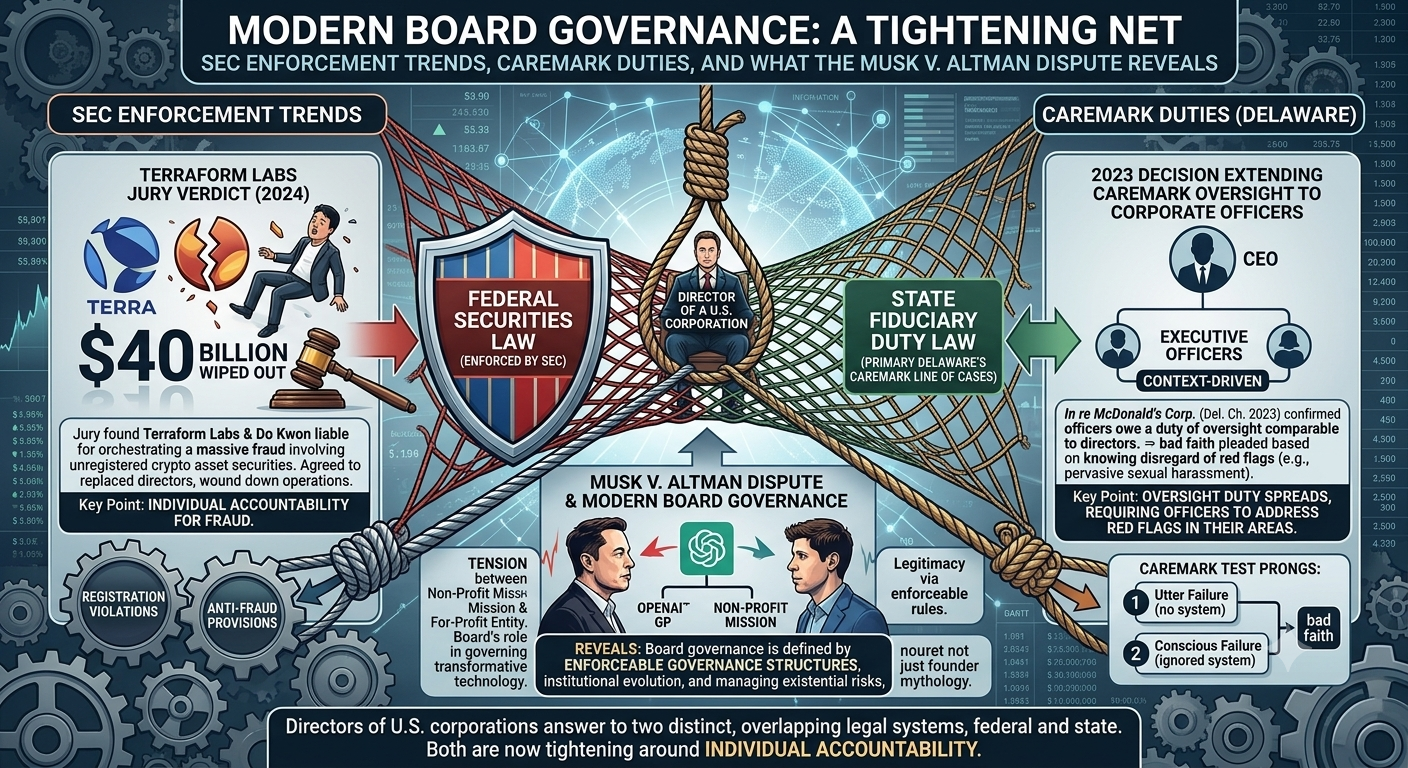
Directors of U.S. corporations answer to two distinct, overlapping legal systems: federal securities law enforced by the SEC, and state fiduciary duty law, primarily Delaware’s Caremark line of cases. Recent rulings (a 2024 jury verdict against Terraform Labs and Do Kwon, and a 2023 Delaware decision extending oversight duties to corporate officers) show both systems tightening around individual accountability. The ongoing Musk v. Altman litigation over OpenAI’s structure remains unresolved; it is a live illustration of how these duties get tested in a fast‑moving, high‑growth technology company, not a decided precedent in itself.
I. Why Do U.S. Directors Face Two Separate Sets of Obligations?
Unlike jurisdictions with a single unified corporations statute, the US splits governance obligations between federal and state law. Federal law, enforced by the SEC, governs disclosure, securities offerings, insider trading, and market integrity. State law (Delaware’s, for the large majority of public companies incorporated there) governs fiduciary duties: care, loyalty, and good faith.
This dual structure means a single decision or disclosure failure can trigger exposure under both systems at once, evaluated by different standards and different courts. Recent cases show both systems moving toward closer scrutiny of individual director and officer conduct, not just corporate‑level penalties.
II. What Did the Terraform Labs Verdict Actually Establish?
On April 5, 2024, a jury found Terraform Labs and its founder Do Kwon liable for securities fraud, violating the anti‑fraud provisions of the Exchange Act and Securities Act, after less than two hours of deliberation. Kwon was found liable specifically as a “control person” of the company. The case concluded with penalties reported at $4.5 billion.
Two principles from the case generalise beyond crypto specifically: public statements and disclosures need to be accurate regardless of whether the underlying inaccuracy was intentional, and control persons (not just the entity itself) can be held personally liable when they are positioned to control the conduct at issue. Directors relying solely on management’s assurances about the accuracy of public statements are taking on real personal risk if those assurances turn out to be wrong.
III. How Did Delaware Extend Oversight Duties to Officers, Not Just Directors?
On January 26, 2023, the Delaware Court of Chancery ruled in In re McDonald’s Corp. Stockholder Derivative Litigation that corporate officers (not only directors) owe a Caremark‑style duty of oversight; this was the first time a Delaware court explicitly extended this duty beyond the boardroom.
The underlying facts involved McDonald’s former chief people officer, disciplined but not immediately terminated after a documented instance of workplace sexual harassment, later terminated for cause after further incidents. Plaintiffs argued he breached his oversight duty by participating in and ignoring red flags about a pattern of misconduct at the company. The court agreed the duty of oversight could reach an officer in that position, not just the board.
| Case | Decided | Significance |
| In re Caremark International Inc. | 1996 | Established the baseline Delaware duty of oversight for corporate directors |
| Marchand v. Barnhill | 2019 | Clarified that boards must actively monitor mission‑critical operational risks, not just respond after harm occurs |
| In re McDonald’s Corp. Stockholder Derivative Litigation | Jan. 2023 | First Delaware ruling holding that corporate officers, not just directors, owe a Caremark‑style duty of oversight |
| SEC v. Terraform Labs & Do Kwon | Apr. 2024 (jury verdict) | Jury found Terraform and Kwon liable for securities fraud; Kwon held liable as a “control person”; $4.5B penalty followed |
The practical lesson generalises well beyond harassment cases specifically: oversight duties in Delaware now clearly extend to any officer positioned to see and act on a compliance red flag, whatever the underlying subject matter.
IV. What Governance Questions Does the Musk v. Altman Dispute Actually Raise?
The lawsuit between Elon Musk and Sam Altman/OpenAI has not produced a final judgment as of this writing, and its outcome should not be assumed either way. What the filings do surface, regardless of how the case resolves, are governance questions relevant to any hybrid nonprofit‑to‑commercial structure: whether a mission‑driven entity’s shift toward a commercial model is consistent with founders’ original representations and fiduciary obligations, how boards should document and justify major structural changes to stakeholders, and how conflicts of interest get managed when the same individuals sit across founder, investor, and governance roles as a company scales rapidly.
These are open questions being tested in litigation, not settled conclusions. Treating the dispute as though it has already established new legal doctrine would be premature; its value to other boards right now is as a cautionary illustration, not as precedent.
(Note: In May 2026, the federal court in Oakland dismissed Musk’s claims against OpenAI on statute‑of‑limitations grounds. This reinforces the thesis that courts have so far bypassed establishing substantive new governance doctrine on the merits, keeping the suit as a cautionary lesson in structure and timing rather than a binding legal precedent.)
V. Where Does AI‑Specific Board Oversight Actually Stand Under Delaware Law?
As of 2026, no Delaware court has yet decided a case specifically testing whether a board breached its Caremark duty by failing to oversee an AI or algorithmic system. What exists instead is informed extrapolation from existing Caremark doctrine: directors are not expected to understand a model’s internals, but they are expected to make a good‑faith effort to design, validate, and supervise systems given their known limitations, and reliance on outside experts or vendors has to be genuinely informed, not passive.
Board preparedness on this front currently lags what commentators recommend; one 2025 survey found only 36% of boards had a formal AI governance framework in place, and just 6% had established AI‑specific management reporting metrics.
Framing this as settled “AI jurisprudence” overstates where the law actually is. The honest position is that existing oversight doctrine will almost certainly be applied to AI‑related failures once a case tests it, and boards would be well served to prepare for that now rather than wait for the first decision to clarify the standard.
VI. What Enforcement Trends Should Directors Actually Watch?
Three patterns worth tracking without overstating them as fixed rules: the SEC has shown continued interest in disclosure accuracy, including incomplete risk disclosures and selective disclosure of material information; Delaware courts have shown a consistent trend toward expecting documented, active oversight rather than passive reliance on management; and there is a discernible shift toward pursuing individual officers and directors, not just the corporate entity, when oversight failures are found.
VI‑B. Enterprise Governance Roadmap: Operationalising Officer Liability and AI Risk
For General Counsels, Chief Risk Officers, and Corporate Directors, the convergence of SEC “control person” enforcement and Delaware’s extended officer Caremark duties fundamentally redefines personal exposure in 2026. Oversight is no longer a passive, board‑level committee function; it is an active, operational obligation running from the C‑suite directly into departmental management.
To insulate both individual executives and the corporate entity from regulatory scrutiny, leadership must move beyond boilerplate governance charters and implement four immediate operational shifts:
Re‑evaluate Officer D&O Coverage and Indemnification: In light of In re McDonald’s, corporate indemnification agreements and Directors and Officers (D&O) liability policies must be updated to explicitly cover key non‑director executives (such as Chief Technology Officers, Chief Information Security Officers, and Chief AI Officers) who manage mission‑critical operational risks.
Establish AI Algorithmic Audit Trails: Because Delaware courts demand active, good‑faith monitoring of core technology platforms, boards cannot treat AI models as opaque “black boxes.” Management must establish verifiable reporting protocols, including third‑party model audits, continuous data‑sourcing compliance checks, and formal safety evaluations, presented to the board on a structured, recurring schedule.
Formalise “Red‑Flag” Escalation Protocols: Individual liability often hinges on whether an officer or director observed a compliance anomaly and failed to act. Corporate compliance programs must maintain documented, direct‑to‑board escalation channels that record both the receipt of operational warnings and the deliberate remedial actions taken in response.
Audit Public Disclosures Against Internal Engineering Realities: Given the SEC’s aggressive posture on control‑person liability post‑Terraform Labs, executive leadership must ensure that public marketing, investor pitch decks, and SEC filings regarding product capabilities (particularly AI readiness and automation) strictly reflect current technical reality rather than aspirational product roadmaps.
VII. A Practical Governance Checklist
- Maintain internal controls proportionate to the company’s actual risk profile, not a generic template.
- Verify the accuracy of public statements independently rather than relying solely on management’s assurance.
- Document board discussions, especially responses to identified red flags.
- Ensure conflicts of interest are disclosed and actively managed, not just noted.
- Build a genuine understanding of the company’s business model and risk exposure, including AI or algorithmic systems in use.
- Stay current on SEC guidance and relevant Delaware case law as it develops.
- Respond to red flags promptly and keep a record of that response.
VIII. What’s Genuinely Unresolved
Two things worth stating without false confidence. First, how Caremark will actually apply to AI oversight failures is untested; commentary and informed extrapolation exist, but no court has ruled, and the eventual standard could turn out stricter or more forgiving than current predictions assume. Second, the Musk v. Altman litigation could resolve in ways that either reinforce or complicate the governance lessons often drawn from it prematurely; boards citing it as settled precedent for hybrid nonprofit structures are, at this stage, citing an argument in progress, not a final ruling.
People Also Ask (PAA) Snippets
PAA 1: How does an officer’s Caremark duty differ from a director’s duty under Delaware law?
While directors owe broad, company‑wide oversight across all business operations, corporate officers owe a Caremark duty of oversight tailored specifically to their operational domain and area of responsibility. Following In re McDonald’s (2023), officers must establish internal reporting systems within their function (e.g., HR, technology, finance) and actively escalate compliance red flags to senior leadership or the board.
PAA 2: What is “control person” liability under SEC enforcement actions?
Under Section 20(a) of the Securities Exchange Act, individuals who exercise managerial control or strategic authority over a corporation can be held personally liable for the entity’s securities fraud. As demonstrated in SEC v. Terraform Labs, executives and controlling directors cannot shield themselves from personal financial penalties simply because fraudulent statements were issued under the corporate name.
PAA 3: Does relying on management or outside vendors satisfy a board’s Caremark AI oversight duty?
No. Delaware Chancery Court precedent (Marchand v. Barnhill) establishes that passive reliance on management or third‑party vendor assurances does not satisfy the duty of good faith. Directors overseeing mission‑critical AI applications must implement independent, documented reporting metrics and make informed inquiries regarding model validation, bias, and deployment risks.
FAQ: SEC Enforcement and Modern Board Governance
Q1: What is the dual governance system for U.S. corporations?
U.S. corporations face federal securities law (SEC‑enforced disclosure and anti‑fraud rules) alongside state fiduciary duty law, primarily Delaware’s duty of care, loyalty, and good faith. Directors must satisfy both simultaneously.
Q2: What did the SEC v. Terraform Labs verdict establish?
A jury found Terraform Labs and Do Kwon liable for securities fraud in April 2024, with Kwon held liable specifically as a control person. It reinforces that individuals in control positions, not just the corporate entity, can face personal liability for inaccurate public statements.
Q3: What is the Caremark duty of oversight?
Originating in the 1996 In re Caremark decision, it requires directors to implement a reasonable system for monitoring compliance risk and to respond to red flags in good faith. In re McDonald’s (2023) extended this duty to corporate officers as well.
Q4: Has Delaware decided a case on AI or algorithmic oversight specifically?
Not yet, as of 2026. Legal commentary extrapolates from existing Caremark doctrine to argue boards should proactively oversee AI systems, but no Delaware court has ruled on a case testing this directly.
Q5: Do corporate officers, not just directors, face oversight liability in Delaware?
Yes, since the 2023 In re McDonald’s ruling, which held that officers in positions to oversee specific risks owe a Caremark‑style duty comparable to that of directors.
Q6: What governance questions does the Musk v. Altman dispute raise?
Questions about mission drift in hybrid nonprofit‑to‑commercial structures, transparency with stakeholders during major structural change, and conflicts of interest as founders take on overlapping roles. The litigation is unresolved, so these remain open questions rather than settled findings.
Q7: How prepared are corporate boards for AI governance in 2026?
Survey data cited in legal commentary suggests meaningfully underprepared: roughly a third of boards have a formal AI governance framework, and a small single‑digit percentage have AI‑specific reporting metrics in place.
Q8: How should directors document oversight efforts?
By keeping records of board discussions, compliance system reviews, responses to identified red flags, and conflict‑of‑interest disclosures; documentation that can later demonstrate good faith rather than passive reliance.
CODA: Key Terms Defined
§1. Caremark Duty
A Delaware fiduciary duty requiring directors (and now officers) to implement a reasonable system for monitoring compliance risk and to respond in good faith to identified red flags. The duty originated in the 1996 In re Caremark decision and was extended to officers in 2023’s In re McDonald’s.
§2. Control Person Liability
Personal liability under Section 20(a) of the Securities Exchange Act for individuals who exercise managerial control over a corporation and are found to have participated in or directed securities fraud. The 2024 Terraform Labs verdict applied this doctrine to Do Kwon as founder and CEO.
§3. AI Algorithmic Audit Trail
A documented, verifiable reporting protocol for monitoring AI systems, including third‑party model audits, data‑sourcing compliance checks, and formal safety evaluations. It is the operational mechanism boards can use to demonstrate good‑faith oversight of AI systems under Caremark.