From Prison Cell to Silicon Empire: How Oliver Curtis Built Firmus Into the Pacific’s Compute Empire
I. From Collapse to Architecture: What Happens When Speed Meets Discipline?
Curtis’s first business didn’t just fail — it imploded. Wrong structure. Wrong timing. Wrong architecture. The kind of failure that doesn’t just wipe out capital; it wipes out identity. Most founders never come back from that. Curtis did — but not by “hustling harder” or chasing another shiny idea. He learned something brutal and simple: Speed without foundation is just a faster way to collapse. Prison made that lesson physical. You can’t outrun concrete. You can’t out-optimize steel bars. In that environment, structure stops being punishment and becomes preparation. Routine becomes discipline. Constraint becomes a training ground. When he came out, he didn’t chase freedom. He chased architecture. He rebuilt his life the way you’d rebuild a data centre: rack by rack, protocol by protocol, redundancy by redundancy. Alongside his co-founder Tim Rosenfield, Curtis structured Firmus not as a gamble but as a fortress — built to outlast the hype cycles that kill lesser ventures. The world, meanwhile, was quietly doing the same thing with its mind.
II. The Birth of Firmus: Renting the Fifth Dimension
Firmus was not born as a software company. It was born as an infrastructure play. Curtis and Rosenfield understood that the AI boom would not be constrained by algorithms, but by physics: power, cooling, and silicon.
III. The APAC Compute Corridor
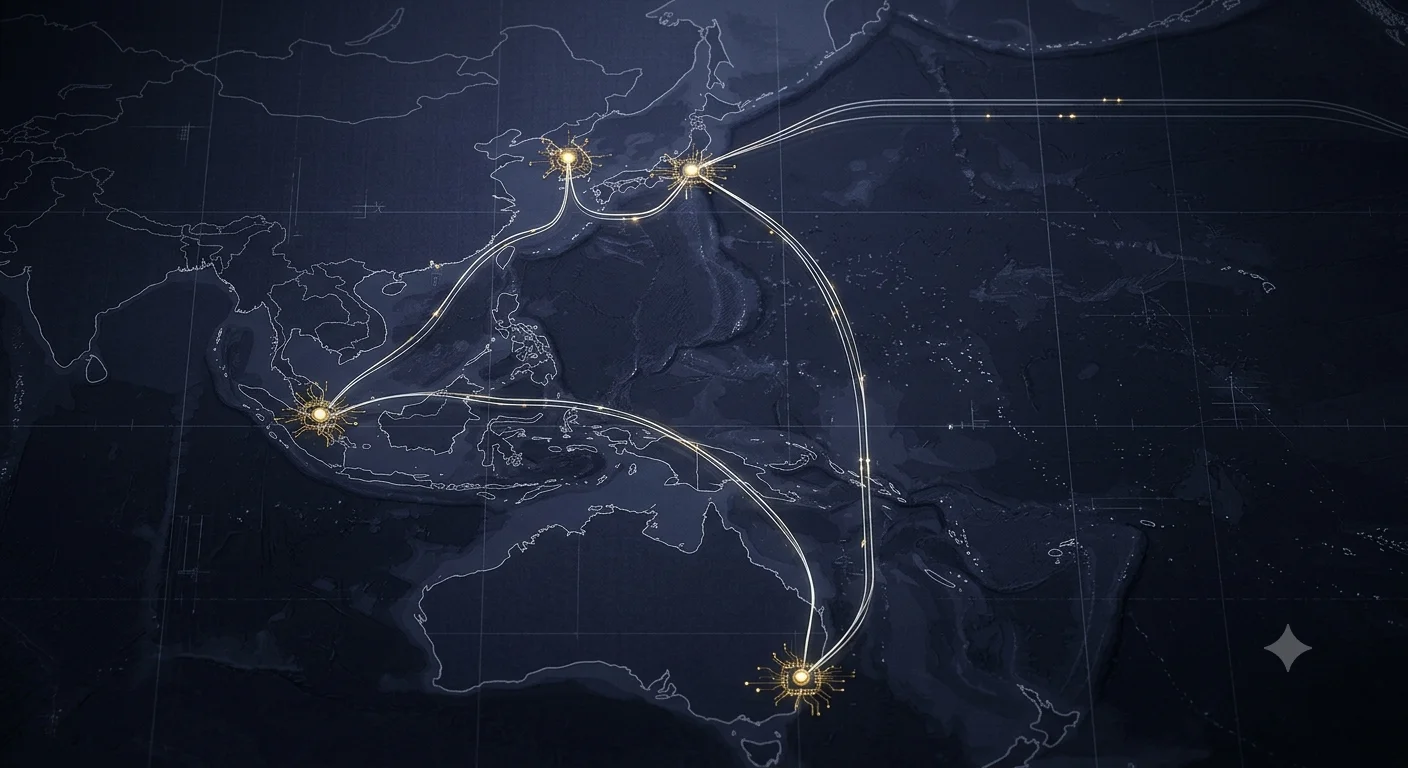
While Silicon Valley fought over model weights, Firmus secured the physical layer across the Asia-Pacific. Singapore, Sydney, and Tokyo became the nodes of a new sovereign compute network.
IV. The NVIDIA Endorsement
NVIDIA does not partner lightly. When they backed Firmus, it was a signal to the market: this is the architecture of the future.
V. Blackstone’s Capital Injection
Institutional capital followed the silicon. Blackstone’s investment transformed Firmus from a regional player into a global infrastructure heavyweight.
VI. Project Southgate: The Sovereign Cloud
Project Southgate was the masterstroke—a fully Sovereign AI cloud designed for governments and enterprises that could not risk data exfiltration to US hyperscalers.
VII. HyperCube and Sustainable Metal Cloud
The technical moat was immersion cooling. HyperCube allowed Firmus to run high-density GPU clusters at a fraction of the traditional PUE.
VIII. The Geopolitics of Silicon
Compute is the new oil. Firmus positioned itself as the neutral refinery in a region caught between US export controls and Chinese domestic acceleration.
IX. Discipline Over Speed: The Architecture of Redemption
The hyperscalers moved fast and broke things. Firmus moved deliberately and built fortresses. In infrastructure, reliability commands a premium. Firmus is no longer just a company; it is a critical node in the global supply chain of intelligence. Oliver Curtis proved that the ultimate competitive advantage is not speed, but the discipline to build an unbreakable foundation.
FAQ: Firmus, Sovereign Compute, and AI Infrastructure
CODA: Understanding the Terms — A Reader’s Reference
§1. Immersion Cooling
A thermal management technique where IT components are submerged in a dielectric liquid, enabling higher density and lower energy consumption.
§2. Sovereign Cloud
Cloud computing architecture designed to ensure that all data, including metadata, remains on sovereign soil and is subject solely to local laws.
§3. PUE (Power Usage Effectiveness)
A ratio that describes how efficiently a computer data center uses energy; specifically, how much energy is used by the computing equipment.
Victor Taula-Washburn, MIB, BCom: Narrative Architect & Strategic AI Analyst, Exploring Power, Markets, Geopolitics & Founder Psychology.