Is Compute Actually the New Oil? Where the Analogy Holds, and Where It Breaks
Extractable Zero‑Click Block
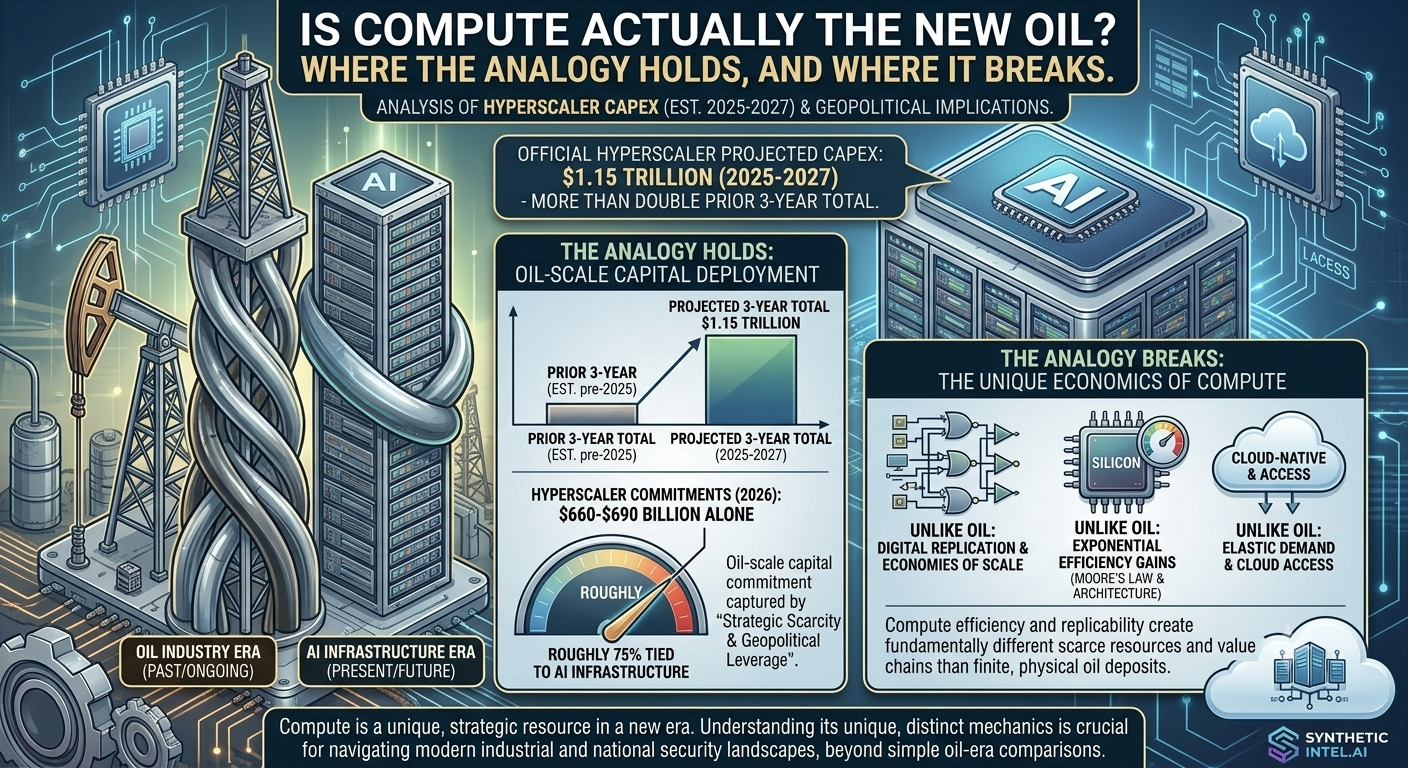
The five largest US hyperscalers committed to between $660 billion and $690 billion in capital expenditure for 2026 alone, roughly 75% of which is tied to AI infrastructure. Goldman Sachs projects total hyperscaler capex from 2025 through 2027 will reach $1.15 trillion, more than double the prior three‑year total. This is oil‑scale capital deployment, and the “compute is the new oil” framing captures something real about strategic scarcity and geopolitical leverage. But the analogy, on close examination, breaks down in specific ways that matter for anyone taking it literally rather than as a useful first approximation.
I. What Does the Compute‑as‑Oil Analogy Actually Capture?
The comparison holds up well on several specific dimensions. Like oil in the 20th century, compute is a scarce input that other economic activity depends on. A nation or company with abundant compute can train better models, run more autonomous agents, simulate more scenarios, and automate more decisions than one without it, in the same way abundant energy once enabled broader industrialisation.
Like oil, compute access is subject to deliberate geopolitical control. The US has imposed detailed export controls on advanced AI chips, with specific restrictions on performance thresholds, memory bandwidth, and interconnect capability, explicitly treating compute as a strategic resource to be gated rather than freely traded.
And like oil‑producing regions historically, the physical infrastructure for compute is now concentrated in specific, sometimes geopolitically fragile locations. A single Gulf campus under construction is rated for multiple gigawatts of power, and the broader US buildout under the Stargate program targets hundreds of billions of dollars over five years. Strategic stockpiling behaviour, sovereign‑level investment, and export‑control fights over the resource all mirror oil‑era patterns closely enough that the analogy earns its keep as a starting framework.
II. Where Does the Analogy Actually Break Down?
The differences matter as much as the similarities, and glossing over them produces bad strategic thinking. Oil is a depleting, consumed resource; a barrel burned is gone. Compute is not consumed in the same sense. A GPU cluster used to train a model today is still there tomorrow, and unlike a barrel of oil, its economic value can actually increase over time as better software and more efficient algorithms extract more useful output from the same underlying hardware.
Compute also improves generationally in a way oil never did. A new chip architecture can deliver an order‑of‑magnitude efficiency gain that makes older infrastructure comparatively less valuable almost overnight; this dynamic has no clean parallel in oil extraction, where a barrel from a 1990s well and a 2020s well are functionally identical.
Crucially, compute’s value is deeply dependent on the software and algorithms running on top of it. The same hardware can be dramatically more or less useful depending on the sophistication of what’s built on it, whereas a barrel of oil delivers essentially the same energy regardless of who refines it.
III. Does Compute Face Anything Like an OPEC‑Style Cartel?
Not currently, and this is one of the more important structural differences. Oil’s geopolitics for decades were substantially shaped by producer cartels coordinating supply. Compute’s supply chain runs through a much smaller and more concentrated set of choke points; overwhelmingly through one dominant chip designer (Nvidia), one dominant advanced fabricator (TSMC), and a handful of lithography toolmakers (principally ASML). This makes the industry’s structure closer to a concentrated supply chain with a few critical monopolists than to a cartel of many producers coordinating output.
This actually makes compute’s supply arguably more fragile to disruption than oil’s historically. Oil supply disruptions from any single producer could usually be partially offset by others increasing output, whereas a disruption at TSMC specifically (discussed at length elsewhere in this series regarding Taiwan Strait tensions) has no comparable near‑term substitute at the same technological tier anywhere in the world.
IV. How Does the Gulf’s Position in Both Oil and Compute Complicate the Analogy?
There is a genuinely interesting recursive element here: the same Gulf states that built their historical wealth and geopolitical relevance on oil are now among the most aggressive investors in compute infrastructure specifically, treating AI infrastructure as the next strategic resource to control regional advantage in (discussed in more detail in the companion piece on Middle East compute hubs in this series). This is not coincidental; it reflects a deliberate strategy of using oil‑era sovereign wealth to buy a strong position in the compute era before hydrocarbon demand potentially declines.
It also means the same regional instability that made oil a geopolitically fraught resource for decades is now a live risk factor for compute infrastructure as well, given how much of the current Gulf compute buildout sits in the same broad region as ongoing Strait of Hormuz tensions. This is a genuine compounding of risk rather than a clean handoff from one strategic resource to an entirely separate one.
V. What Does the Energy Demand Side of This Actually Look Like?
One area where the oil analogy holds almost too well: compute’s insatiable and rapidly growing demand for actual energy. Training and running frontier AI models at scale requires enormous, continuous electricity supply, which is why AI infrastructure buildouts are increasingly gated not by chip availability alone but by whether a given location can actually secure enough stable power and cooling capacity (the exact constraint discussed in this series regarding Iran’s compute ambitions, where abundant hydrocarbon reserves haven’t translated into usable data‑centre power due to grid instability).
This creates an ironic dependency: compute, often framed as oil’s successor as the strategic resource of the era, is in practice deeply dependent on the same underlying energy infrastructure, including, in many cases, natural gas and other hydrocarbons, that oil‑era power once was. The “new oil” isn’t replacing the old one; in a real sense, it’s currently running on it.
VI. What’s the Actual Strategic Implication of Treating Compute This Way?
If policymakers and investors take the compute‑as‑strategic‑resource framing seriously (which the scale of current capital expenditure suggests they already do), the practical implications differ in specific ways from historical oil strategy. Stockpiling chips has limited long‑term value given how quickly hardware generations turn over, unlike oil, which can be stored indefinitely at relatively stable value. Strategic advantage is more durably built through control of the supply chain choke points (advanced fabrication and lithography specifically) than through accumulating finished chips, since finished inventory depreciates in relative usefulness far faster than a barrel of crude does.
This is precisely why the current wave of export controls targets not just finished chips but the entire fabrication and equipment stack beneath them; a policy approach that only makes sense once you take seriously that compute’s strategic value decays over time in a way oil’s never did, making control of ongoing production capability more valuable than control of any given moment’s inventory.
VI‑B. Strategic Implications for Enterprise Risk
For C‑suite executives, boards, and enterprise risk officers, the “compute as oil” analogy demands an immediate re‑evaluation of vendor lock‑in and long‑term procurement strategy. While the geopolitical posturing around semiconductor export controls dominates macroeconomic headlines, the immediate, actionable risk for the enterprise lies in hyperscaler CapEx concentration and the debt‑fueled nature of the 2026 AI infrastructure buildout. With current projections indicating hyperscaler infrastructure spending will exceed $1.15 trillion between 2025 and 2027, corporate decision‑makers must recognise that this unprecedented scale of capital deployment requires an aggressive, accelerated return on investment; returns that will ultimately be extracted from enterprise customers.
Unlike oil, which historically traded on highly liquid and relatively transparent global spot markets, modern compute is gated by a deeply opaque, vertically integrated stack. In this environment, hyperscalers hold unilateral power to dictate terms, allocate capacity, and adjust pricing. If your organisation’s digital transformation strategy relies entirely on a single vendor’s closed AI ecosystem, you are fundamentally exposed to their specific supply chain choke points; spanning from advanced packaging constraints at TSMC to localised power grid failures at their primary data centre campuses.
To mitigate this concentrated risk, executive leadership must implement a deliberate compute resilience strategy. This requires diversifying foundational model dependencies, actively investing in smaller, domain‑specific open‑source models that can operate on hybrid or localised hardware, and rigorously auditing the true total cost of ownership (TCO) for enterprise AI deployments. The actual cost of compute is no longer just the direct price of an API call or compute instance; it increasingly includes the embedded premium of the hyperscaler’s massive debt servicing. Future‑proofing the enterprise means abandoning the assumption of infinitely abundant, continuously cheap compute, and instead treating AI infrastructure access as a finite, fiercely contested operational resource.
VII. What’s the Honest Bottom Line on the Analogy?
“Compute is the new oil” is a useful first approximation, genuinely useful for understanding why nations and companies are deploying capital at oil‑scale magnitudes, why export controls have become a central tool of AI policy, and why the same Gulf states that built power on hydrocarbons are now racing to build power on compute instead. It becomes actively misleading if taken further than that: compute doesn’t deplete, it appreciates with better software, its supply chain is concentrated in a handful of monopolists rather than many producers, and, most ironically, it remains deeply dependent on the very energy infrastructure the oil era built.
The accurate framing treats compute as a genuinely new kind of strategic resource that shares oil’s geopolitical gravity without sharing its underlying physical or economic logic, and strategy built on the analogy alone, without accounting for where it breaks, will misjudge exactly the dynamics (stockpiling, supply chain concentration, energy dependency) that matter most.
FAQ: Compute as a Strategic Resource
Q1: How much are hyperscalers actually spending on AI infrastructure in 2026?
The five largest US hyperscalers committed to $660‑690 billion in 2026 capital expenditure, nearly double 2025 levels, with roughly 75% (about $450 billion) specifically tied to AI infrastructure.
Q2: How does compute differ from oil as a strategic resource?
Compute isn’t consumed when used and its economic value can increase over time as software improves, unlike oil, which is depleted upon use and delivers consistent value regardless of era. Compute also improves generationally in ways oil never did.
Q3: Is there an OPEC‑style cartel controlling compute supply?
No. Compute’s supply chain runs through a small number of concentrated monopolists, principally Nvidia for chip design, TSMC for advanced fabrication, and ASML for lithography, rather than a cartel of coordinating producers.
Q4: Why does the Gulf region matter for both oil and compute strategy?
Gulf states are using oil‑era sovereign wealth to build major AI compute infrastructure, treating it as the next strategic resource, while the same regional instability that historically affected oil markets now poses a live risk to that compute infrastructure as well.
Q5: Does compute strategy mirror oil stockpiling?
Not effectively. Chip stockpiling has limited long‑term value given rapid hardware generational turnover; durable strategic advantage comes from controlling ongoing fabrication and equipment supply chains rather than finished chip inventory.
Q6: Is compute actually independent of oil‑era energy infrastructure?
No. Training and running AI at scale requires enormous, continuous electricity, often still generated from hydrocarbons, meaning compute infrastructure buildouts remain gated by the same energy and grid constraints that shaped the oil era.
CODA: Key Terms Defined
§1. Hyperscaler CapEx
Capital expenditure by the largest cloud infrastructure providers (Microsoft, Alphabet, Amazon, Meta, Oracle) on data centres, servers, networking equipment, and AI‑specific hardware. The 2026 wave exceeds $660 billion, with roughly 75% directed at AI infrastructure.
§2. Supply Chain Choke Points
Critical, concentrated points in a production chain where disruption cannot be easily substituted. In compute, these include Nvidia (chip design), TSMC (advanced fabrication), and ASML (lithography equipment). Unlike oil’s more distributed supply, compute’s choke points are singular and fragile.
§3. Compute Resilience Strategy
A deliberate enterprise approach to mitigating vendor lock‑in and supply chain risk by diversifying foundational model dependencies, investing in open‑source alternatives, and auditing true total cost of ownership across AI deployments.