Answer Engine Optimization (AEO): Winning AI Overviews in the Zero-Click Era
Extractable Zero‑Click Block
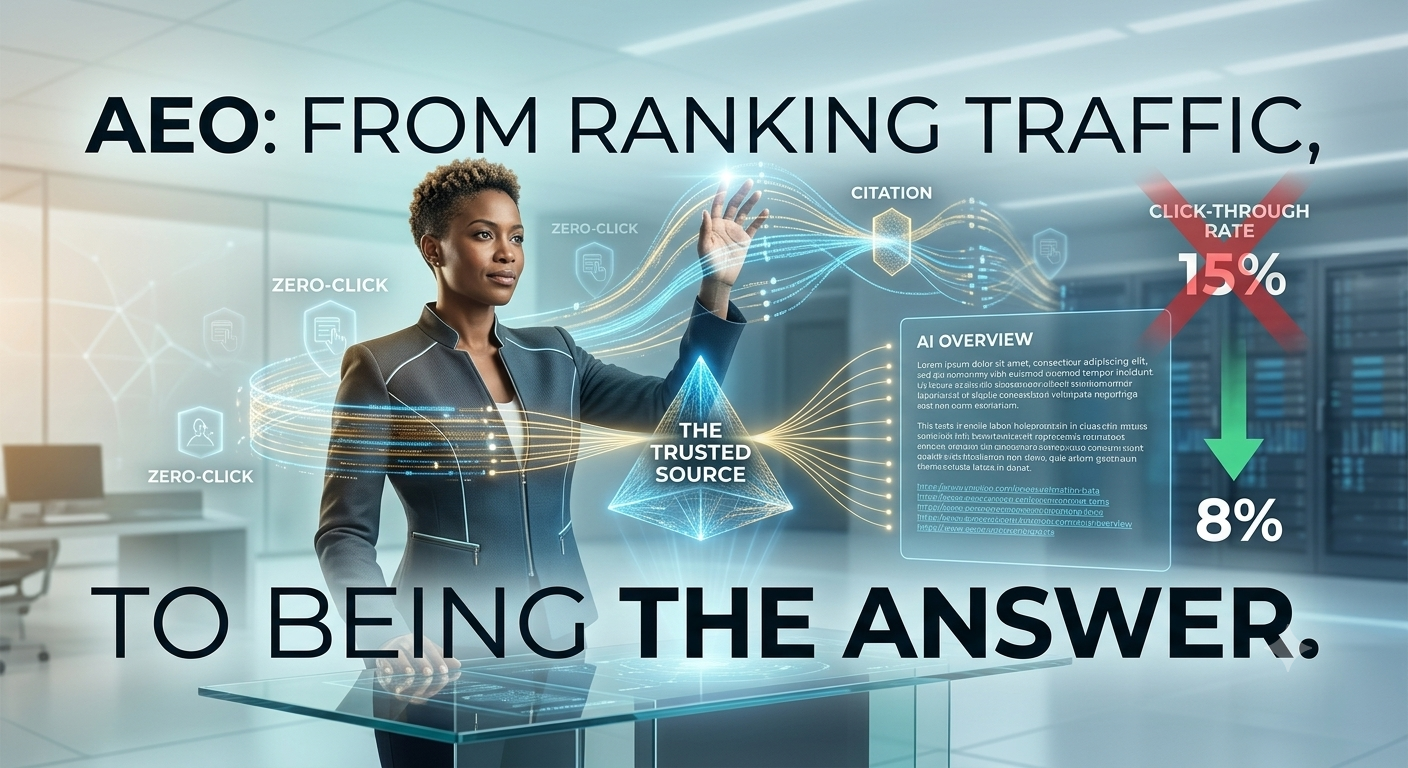
Answer Engine Optimization (AEO) is the practice of structuring content so AI systems and search engines can extract, cite, and surface it without requiring a click. As of mid-2026, 68% of US Google searches end without a click – and where an AI Overview appears, Pew Research found the click-through rate roughly halves (15% down to 8%). Visibility now depends on becoming the source that algorithms trust enough to synthesise, not ranking for traffic but ranking for algorithmic citation. This is the shift from Search Engine Optimization to Answer Engine Optimization; from ranking to being the answer.
I. Why Is Traditional SEO Losing Traffic to Zero‑Click Search?
The search landscape is shifting faster than most businesses realise. The legacy model of ranking for blue links is dissolving, replaced by an architecture where answers appear instantly and users never leave the results page.
This is the rise of zero‑click search, and it is fundamentally changing how information must be structured if it wants to be seen at all.
In the first four months of 2026, 68.01% of US Google searches ended without a click, up from 60.45% in 2024 – a 7.56-point jump in two years, according to SparkToro’s 2026 zero-click study (based on Similarweb clickstream data). The effect is sharpest where AI Overviews appear: Pew Research found users clicked a result just 8% of the time when an AI Overview was present, versus 15% when it wasn’t – and only 1% clicked a link inside the Overview itself. The pattern is consistent across datasets: the more the answer surfaces on the page, the less the click survives.
This did not happen overnight. It is the result of a decade‑long push toward answer engines rather than search engines. Google’s stated goal is to eliminate friction, shorten the path to knowledge, and retain the user inside its own ecosystem. Featured snippets, People Also Ask boxes, AI Overviews, and Knowledge Panels all serve this purpose.
The result is an environment where visibility is no longer about traffic. It is about being the foundational answer an AI system chooses to extract.
II. What Is Answer Engine Optimization and How Does It Differ from SEO?
AEO flips the traditional SEO model on its head. Instead of optimising for keywords, you optimise for interrogatives, intent, and machine‑readable clarity.
Traditional search engines matched text strings. Modern answer engines use Retrieval‑Augmented Generation (RAG) to read, comprehend, and synthesise concepts. Google’s own guidance emphasises that its systems reward content demonstrating expertise, accuracy, and helpfulness; signals that map directly to E‑E‑A‑T (Experience, Expertise, Authoritativeness, Trustworthiness).
Where SEO asks: “How do I rank for this term?” AEO asks: “How do I become the source the algorithm cites?”
The shift is not tactical. It changes what gets built, who gets budget, and how a company measures whether its content is working at all.
| Feature | Traditional SEO | Answer Engine Optimization (AEO) |
| Primary goal | Rank in the ten blue links to drive a click | Be cited as a primary source in an AI‑generated answer |
| Success metric | Organic traffic, click‑through rate, rankings | Citation frequency, Share of Model, branded search volume |
| Content focus | Keyword density, broad long‑form guides | Direct‑answer architecture, modular structure, entity clarity |
| Trust signal | Backlink velocity, domain authority | Data provenance, schema markup, topical authority (E‑E‑A‑T) |
III. How Does Zero‑Click Search Impact Business Models?
Zero‑click search is not merely a UX trend. It is a business‑impacting structural shift. When users stop clicking, traditional traffic models collapse. Publishers lose ad revenue. B2B websites lose organic leads. Brands lose the chance to build a direct relationship with the visitor before they ever convert.
Zero‑click behaviour is especially dominant on mobile, where users default to the fastest available answer rather than a page they have to load and scan. This means even a page holding the top organic position can see traffic decline while its ranking stays flat.
The implication is direct: rank no longer guarantees relevance.
If users are not clicking, the only remaining path to visibility is becoming the underlying data source the AI uses to construct its answer. Writing persuasively is no longer sufficient. Content also has to be structured so a machine can parse it efficiently.
IV. How Do You Optimize Content for AI Overviews?
The rollout of AI Overviews pushes this shift toward its terminal velocity. AI‑generated summaries pull from multiple sources and synthesise them into one answer. Unstructured content is bypassed in favour of sources that carry less computational friction to extract.
Testing across AI search surfaces (Google AI Overviews, Perplexity, ChatGPT Search, Bing Copilot) consistently favours content with:
- Clear claims: direct, unambiguous statements free of marketing filler.
- Explicit sourcing: named references, primary data, verifiable methodology.
- Entity markup: FAQPage, Article, ClaimReview, and Organisation JSON‑LD schema.
The source that wins is not the one with the highest domain rating. It is the one with the highest extraction fidelity.
V. What Is Topical Authority and Why Does It Replace Keyword Strategy?
Zero‑click search forces a move away from isolated keyword targeting. The goal becomes owning the complete informational territory around a concept.
This requires building a dense semantic footprint: a pillar‑cluster architecture that answers not just the primary question but the surrounding sub‑questions, increasing the likelihood that content is mapped into the knowledge graph as a definitive entity.
Gartner has projected a 25% decline in traditional search volume by 2026 as generative AI systems become substitute answer engines, with B2B buyers adopting AI search roughly three times faster than consumers. The winner in this environment is not the site with the most pages. It is the site with the most complete, interconnected semantic web.
Entity salience (how search engines mathematically map brand authority across a knowledge graph) is becoming the functional successor to PageRank.
VI. The Financial Architecture of Algorithmic Citation
For the C‑suite and marketing leadership, AEO is not a marketing tactic. It is an infrastructure mandate.
The most costly mistake a modern executive can make is evaluating 2026 search performance using 2023 metrics. As AI Overviews absorb top‑of‑funnel informational queries, raw organic sessions will decline by design. A marketing team judged strictly on click‑through rate and direct organic traffic will misdiagnose that decline as failure; and abandon the exact strategy the next decade requires.
The shift to AEO requires rebuilding how ROI is modelled. In the zero‑click era, the pipeline moves from traffic‑to‑lead to citation‑to‑brand.
When a procurement officer asks an AI agent for the best enterprise cybersecurity solutions and a firm is synthesised as the primary recommendation, that firm receives zero clicks in the moment. Days later, the same officer may run a direct branded search or navigate straight to the vendor’s site to submit an RFP. Under a legacy attribution model, organic search gets no credit for that outcome. Under an AEO attribution model, the AI citation is recognised as the origin point of the assisted conversion.
Operationalising this means reallocating budget from volume‑based content production toward high‑density, proprietary research. The spend is no longer aimed at earning a user’s click. It is aimed at earning a language model’s recommendation.
Market share in the 2020s was won by whoever mastered the search engine. Market share in the 2030s will be won by whoever masters the answer engine.
VI‑B. Strategic Implications for Enterprise Infrastructure: Multimodal AEO and Autonomous Agents
For C‑suite executives and digital infrastructure leads, Answer Engine Optimization extends far beyond defending against Google’s text‑based AI Overviews; it is the prerequisite data architecture for the coming wave of multimodal commerce. Enterprises are rapidly shifting capital expenditure away from legacy, static website development and into interactive AI answering systems, automated lead‑capture funnels, and digital receptionist infrastructure. However, deploying a state‑of‑the‑art voice agent is entirely useless if the underlying corporate data cannot be instantly and reliably extracted.
When a high‑value prospect interacts with an automated business agent over the phone or via a conversational interface, that agent relies on Retrieval‑Augmented Generation (RAG) to instantly synthesise policy, pricing, and capabilities. If the enterprise’s digital footprint lacks strict JSON‑LD schema, explicit sourcing, and rigid entity resolution, the internal voice agent will either hallucinate or fail to progress the prospect through the sales funnel.
Furthermore, as AI infrastructure iterates rapidly, moving beyond earlier paradigms into the sophisticated reasoning capabilities of generation 2.5 models, the reliance on strictly formatted, machine‑readable data only intensifies. A modern AI system does not infer meaning from clever marketing copy; it demands extraction fidelity. AEO is the critical bridge between raw corporate data and high‑margin autonomous AI deployment. The executive mandate for 2026 is clear: restructure your content so it can be seamlessly extracted not just by external search engines, but by your own internal digital workforce. If your data is unstructured, your automated systems cannot function, and your brand becomes invisible to the machines making procurement decisions.
VII. What Are the Open Questions in Algorithmic Citation?
Zero‑click search concentrates real power in a small number of platforms that decide which sources get synthesised and which get bypassed entirely. That concentration raises questions worth naming plainly rather than folding into a metaphor: who is accountable when an AI Overview misrepresents a cited source? What recourse does a publisher have when its content is extracted and paraphrased without a click, a byline, or revenue attached? And as more categories of search collapse into zero‑click answers, does the diversity of information sources reaching the end user shrink along with it?
These are not hypothetical. Publishers have already raised the first two with search platforms directly, and regulators in the EU and US have opened inquiries into whether AI‑generated summaries of news content constitute fair use or require compensation. None of this is settled. Any organisation building an AEO strategy should treat that uncertainty as a live variable, not a solved problem; the rules governing citation, attribution, and compensation in AI search are still being written, largely by the platforms themselves.
VIII. Who Will Own the Future of Visibility?
The brands that win this transition will be the ones that write simultaneously for human judgment and machine parsability: answering questions directly, citing verifiable sources, and treating schema architecture as a core strategy rather than an IT afterthought.
The search world built its advantage through ranking. The AEO world is building its advantage through citation. The practical test is the same either way: can your content be trusted enough (by a person or a retrieval system) to be the one thing pointed to when the question gets asked.
People Also Ask (PAA) Snippets
PAA 1: Does zero‑click search mean traditional SEO is dead?
Traditional SEO is not dead, but its primary function has fundamentally changed. While optimising for ten blue links is yielding diminishing returns due to the rise of zero‑click search, the foundational mechanics of SEO (such as technical site speed, crawlability, and indexing) remain prerequisites. However, winning visibility now requires upgrading those tactics to Answer Engine Optimization (AEO), where the goal is achieving algorithmic citation inside an AI Overview rather than driving a direct click.
PAA 2: How do you measure success in Answer Engine Optimization (AEO)?
Because AEO often results in zero‑click interactions on the initial search, success cannot be measured by raw organic sessions or click‑through rates (CTR). Instead, organisations must track “Share of Model” (how often an AI synthesises your brand as the definitive answer), increases in direct branded search volume following informational queries, and the deployment of AI‑specific attribution models that credit LLM referrals as the origin point of assisted conversions.
PAA 3: What JSON‑LD schema is required for AI Overviews?
AI models prioritise content with the lowest computational friction. To ensure extraction, pages must deploy comprehensive JSON‑LD schema markup, specifically utilising FAQPage, Article, ClaimReview, and Organisation entities. This structured data acts as a direct API for AI crawlers, allowing them to instantly classify the page’s claim‑space, verify its methodology, and confidently cite it in an AI‑generated summary.
FAQ: AEO and the Zero‑Click Search Era
Q1: What is Answer Engine Optimization (AEO)?
AEO is the practice of structuring content so search engines and AI systems can extract, cite, and surface it directly in results; optimising for algorithmic answers rather than user clicks.
Q2: What is zero‑click search and why does it matter?
Zero-click search occurs when users find answers directly on the results page without clicking through to a website. As of mid-2026, roughly 68% of US Google searches end without a click (SparkToro, 2026), and when an AI Overview appears, clicks to results drop by nearly half (Pew Research).
Q3: How is AEO different from traditional SEO?
SEO optimises for keywords and backlinks to drive human traffic. AEO optimises for interrogatives, intent, and machine‑readability to earn algorithmic citation and inclusion in AI‑generated answers.
Q4: What are E‑E‑A‑T principles and why do they matter for AEO?
E‑E‑A‑T (Experience, Expertise, Authoritativeness, Trustworthiness) is Google’s framework for evaluating content quality. AEO‑aligned content demonstrates E‑E‑A‑T through verifiable evidence, named sources, and transparent methodology.
Q5: How do AI Overviews change content strategy?
AI Overviews synthesise information from multiple sources into a single answer. Content needs to be machine‑readable, structured with JSON‑LD schema, and dense enough to reduce the computational cost of extracting it.
Q6: What is topical authority and how does it replace keyword strategy?
Topical authority means owning the complete informational territory around a subject through pillar pages, supporting content, and semantic clusters, mapping to the knowledge graph instead of chasing isolated keywords.
Q7: How do you make content machine‑readable for AI systems?
Use strict heading hierarchy, JSON‑LD schema markup (FAQPage, Article, ClaimReview), concise answer blocks beneath headings, and named citations.
Q8: How do you measure ROI in a zero‑click search environment?
Shift away from raw organic sessions. Track Share of Model (how often an AI cites the brand), increases in direct branded search volume, and assisted conversions traceable to LLM referrals.
Q9: What is the difference between AEO and Generative Engine Optimization (GEO)?
AEO covers any engine that provides direct answers, including voice search and featured snippets. GEO is a narrower discipline focused specifically on optimising content for LLMs and generative interfaces like Perplexity and ChatGPT.
Q10: How does Retrieval‑Augmented Generation (RAG) affect how AI Overviews select sources?
RAG lets AI models pull real‑time facts from external sources before generating an answer. To be selected by a RAG system, content needs to be structured, factual, and free of the marketing language that confuses retrieval algorithms.
CODA: Key Terms Defined
§1. Extraction Fidelity
A measure of how cleanly and reliably an AI system can extract key facts, entities, and claims from a piece of content. High extraction fidelity means minimal computational friction; low extraction fidelity means the system has to work harder to parse meaning, increasing the chance it will bypass the source.
§2. Share of Model
An emerging AEO metric tracking how frequently a brand, domain, or specific piece of content is cited as a source within AI‑generated answers across major LLMs (ChatGPT, Perplexity, Claude, Google AI Overviews). It is the zero‑click equivalent of organic search market share.
§3. Computational Friction
The cognitive or computational cost an AI system incurs when processing a piece of content. Content with high computational friction (e.g., marketing fluff, vague claims, unstructured data) is deprioritised; content with low computational friction (e.g., direct answers, structured data, clear entities) is extracted and cited.