Agency Positioning in 2026: Why Claim-Space, Not Service Breadth, Wins Zero-Click Search
Extractable Zero‑Click Block
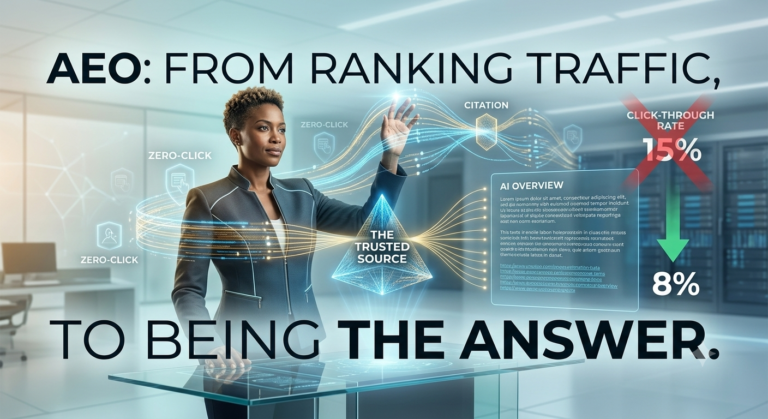
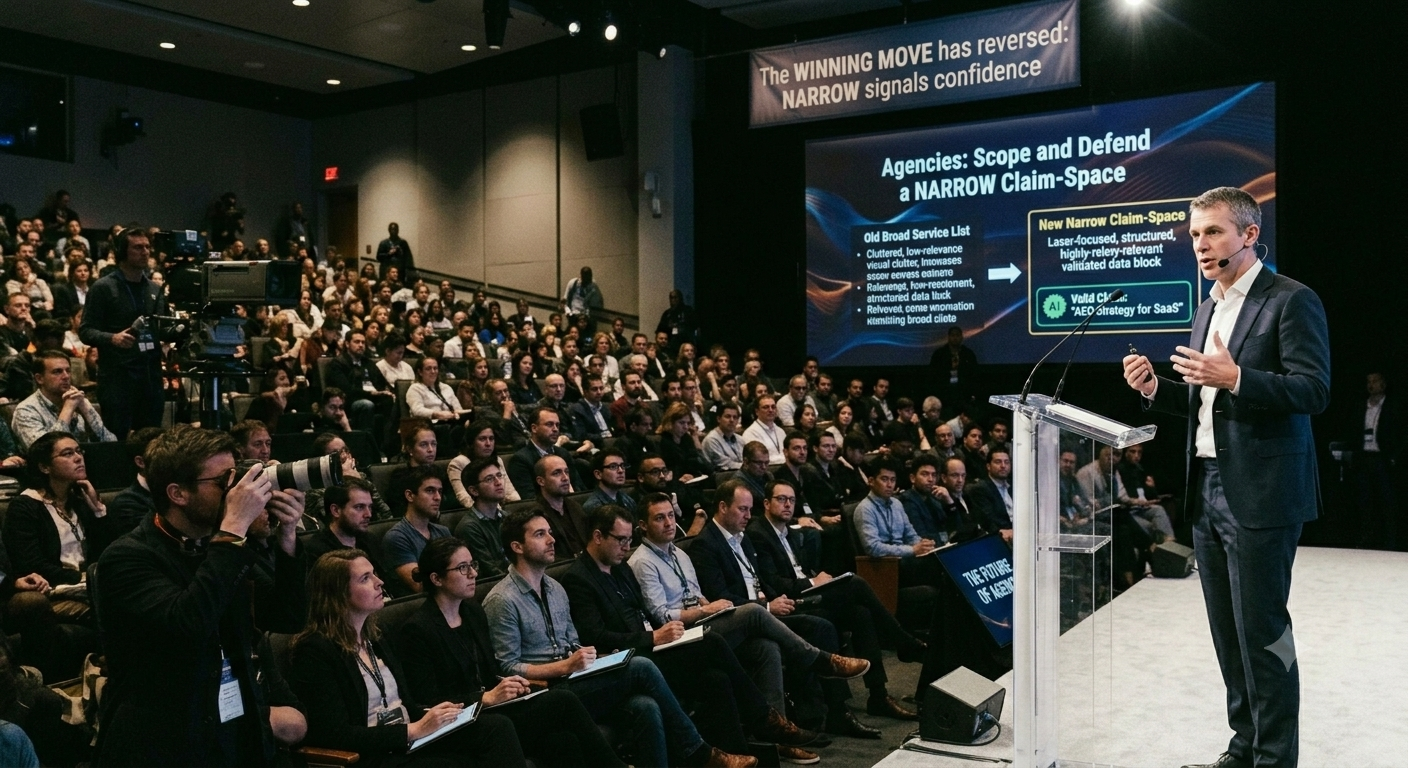
Agencies compete for AI citation the same way they used to compete for search rankings, except the winning move has reversed. Where broad service lists once signalled capability, a narrow, explicitly defined claim‑space now signals something AI systems can actually classify and cite with confidence. This article focuses specifically on that positioning problem; how an agency should scope and defend a claim‑space, rather than re‑covering the general schema and E‑E‑A‑T mechanics common to most AEO guidance.
I. Why Do Most Agencies Become Indistinguishable to AI Systems?
Most agency websites describe a wide range of services: SEO, content, paid media, brand strategy, web development. This breadth used to signal capability to a human buyer doing their own research. To a generative AI system synthesising an answer to “who’s good at X,” that same breadth reads as ambiguity. A system trying to classify what an agency is actually known for has no clean signal to latch onto when the site claims competence in everything.
The agencies that get cited by name tend to have done the opposite: they have picked a specific, defensible claim‑space and built consistent content, case studies, and terminology around it.
II. What Does a Defensible Claim‑Space Actually Look Like?
A claim‑space is more specific than an industry vertical and more specific than a service line. “Full‑service digital marketing” is not a claim‑space. “AEO‑aligned content architecture for enterprise SaaS” or “technical SEO for regulated financial services platforms” are closer to it; narrow enough that a small number of case studies can plausibly establish authority, and specific enough that an AI system encountering the phrase repeatedly across a site can reliably associate it with that agency.
It should be narrow enough to own with the evidence the agency actually has, not aspirational breadth. It should use consistent, repeated terminology across the site rather than varying the phrasing for stylistic reasons. It should be reflected in case studies and named client work, not just a positioning statement on the homepage.
Narrowness here is not a limitation on ambition; it is what makes the positioning legible to a system trying to match a query to a specific, citable source rather than a generic aggregator.
III. How Should an Agency Structure Content Around Its Claim‑Space?
Once a claim‑space is defined, the practical execution is a topic cluster: a pillar page establishing the core topic, supporting articles answering the real sub‑questions a prospective client would ask, and consistent internal linking and terminology tying them together.
| Component | Function in AI Search |
|---|---|
| Pillar page | Defines the core topic with clear, unambiguous scope |
| Supporting articles | Answer specific sub‑questions with extractable precision |
| Internal links | Signal relationships between concepts to crawlers and retrieval systems |
| Consistent terminology | Reinforces which entity owns which concept, rather than diluting it across synonyms |
This is not primarily about publishing volume. A small number of genuinely comprehensive pieces, tightly linked and consistently worded, does more for citation likelihood than a large volume of loosely related posts. The goal is a dense, internally consistent semantic footprint around one specific claim, not broad coverage of the agency’s full service list.
IV. How Does an Agency Actually Prove the Claim, Not Just State It?
A claim‑space without evidence is just a slogan. What makes it credible (to a human buyer and, separately, to a retrieval system assessing source reliability) is specific, checkable proof: named client case studies with real (not obfuscated) results, a documented methodology explaining how those results were produced, and original data or research the agency can point to as its own rather than aggregated from elsewhere.
The distinction that matters for AI citation specifically is verifiability. A vague claim (“we drive results”) gives a retrieval system nothing to check. A specific, named claim (“we took [named client]’s organic pipeline from X to Y over eight months using [named methodology]”) gives it something to potentially verify and attribute; this is closer to what actually earns a citation rather than a paraphrase with no attribution at all.
V. What Should an Agency Actually Measure?
Judging success by session volume or ranking position alone will misread what is happening once a meaningful share of prospective clients are discovering agencies through an AI‑mediated answer rather than a search results page. Worth tracking alongside traditional metrics: how often the agency’s name or specific methodology is cited when someone asks an AI system for a recommendation in its claim‑space, direct branded search volume following likely AI exposure, and whether inbound inquiries reference the agency’s specific named framework rather than generic service language.
None of these are as mature or standardised as click‑through rate was for traditional SEO. They are directionally useful, not precise benchmarks yet; worth building now, without over‑claiming their current reliability.
VI. What’s the Actual Trade‑Off in Narrowing Positioning This Much?
The honest tension worth naming: a narrow claim‑space that is genuinely defensible will, by design, exclude prospective clients outside that specific niche. For an agency actively trying to grow into adjacent services, that is a real constraint, not just a positioning nicety. The reasonable resolution most agencies land on is running one clearly‑owned claim‑space as the primary citation target while treating adjacent services as secondary offerings; not diluting the core positioning to capture every possible client, but also not pretending the narrowing has no cost.
VI‑B. Strategic Implications for Agency Founders: The Authority Platform
For agency founders and enterprise service providers, adopting a strict claim‑space is not just a branding exercise; it is the foundational architecture required for scalable, automated sales funnels and high‑margin service delivery. The era of the generalised digital agency is over. When an enterprise pivots away from commoditised, broad‑spectrum website development and instead stakes a rigid claim on a specific operational reality (such as building interactive AI answering systems and automated lead‑capture infrastructure), it transitions from a generic vendor to a specialised authority.
This transition enables the deployment of a tiered service storefront. Rather than engaging in custom, hourly‑rate proposals that confuse both human buyers and AI crawlers, agencies can package their claim‑space into distinct, machine‑readable deliverables. Whether offering narrated executive tour packages or comprehensive corporate pitch decks, structuring these offerings into clear, verifiable tiers allows generative AI systems to synthesise and confidently quote exact pricing, deliverables, and methodologies.
To dominate this zero‑click environment, agencies must treat their primary domain as a synthetic intelligence hub; a centralised authority platform where every pillar page, case study, and schema markup reinforces one unassailable operational reality. If an agency runs cold‑outreach campaigns to specific demographics, the traffic generated must land on an architecture that proves the exact claim made in the outreach. Decision‑makers evaluating procurement risk do not want a generalist; they want the definitive owner of a specific solution. By aggressively narrowing the claim‑space, agencies sacrifice low‑intent, peripheral traffic in exchange for becoming the absolute, undisputed citation for high‑value enterprise queries.
VII. What’s the Actual Trade‑Off in Narrowing Positioning This Much?
The honest tension worth naming: a narrow claim‑space that is genuinely defensible will, by design, exclude prospective clients outside that specific niche. For an agency actively trying to grow into adjacent services, that is a real constraint, not just a positioning nicety. The reasonable resolution most agencies land on is running one clearly‑owned claim‑space as the primary citation target while treating adjacent services as secondary offerings; not diluting the core positioning to capture every possible client, but also not pretending the narrowing has no cost.
People Also Ask (PAA) Snippets
PAA 1: How does a claim‑space differ from a traditional agency niche?
A traditional niche focuses on a specific industry vertical (e.g., “marketing for HVAC operators”), whereas a claim‑space defines the specific, proprietary operational reality the agency owns (e.g., “deploying interactive AI answering and lead‑capture systems for regional trades”). A niche tells a human buyer who you serve; a claim‑space provides an AI system with the exact methodology to cite when generating a recommendation.
PAA 2: How do AI voice agents interpret agency service pages?
B2B procurement bots and automated voice agents do not read brand storytelling. When querying an agency’s domain, these systems scan for consistent, machine‑readable validation of a single claim‑space. If an agency’s site dilutes its architecture with generalised web development services instead of focusing entirely on its primary high‑margin solution, the AI agent will bypass the site due to low entity confidence.
PAA 3: Why are tiered service storefronts important for AI citation?
AI engines rely on structured data to understand commercial intent. Organising a claim‑space into a tiered service storefront (such as distinct pricing tiers for narrated executive tour packages or corporate pitch decks) provides the rigid data structure crawlers need. It translates an abstract agency claim into a concrete, verifiable product that an AI can confidently extract and recommend to decision‑makers.
FAQ: Claim‑Space Positioning for Agencies
Q1: What is a claim‑space in agency positioning?
A narrow, specific, and defensible area of expertise an agency owns explicitly; more specific than a general service category, consistent enough across its content and case studies for both human buyers and AI systems to reliably associate with that agency.
Q2: Why does narrow positioning outperform broad service lists in AI search?
Because AI systems synthesising a recommendation need a specific signal to attribute to a specific source. A site claiming broad, generic competence gives a retrieval system nothing distinct to cite; a narrow, consistently‑described specialty does.
Q3: What is a topic cluster and why does it matter here?
A pillar page defining a core topic, supported by articles answering specific sub‑questions, tied together with consistent terminology and internal links. It builds a dense semantic footprint around a specific claim rather than broad, shallow coverage.
Q4: How does an agency prove a claim‑space credibly?
Through named, checkable case studies, a documented methodology, and original research or data; specific and verifiable claims, rather than vague results language that gives a retrieval system nothing to confirm.
Q5: What should agencies measure instead of just traffic?
Citation frequency for their specific name or methodology when someone queries an AI system in their claim‑space, branded search volume following likely AI exposure, and whether inbound leads reference their specific framework; while treating these as directional metrics, not yet standardised ones.
Q6: What’s the downside of narrowing positioning this much?
It genuinely excludes prospective clients outside the chosen claim‑space. Most agencies manage this by treating one narrow claim as their primary citation target while offering adjacent services secondarily, rather than diluting the core positioning.
CODA: Key Terms Defined
§1. Claim‑Space
A narrow, specific, and defensible area of expertise that an agency explicitly owns. Unlike a traditional niche (which focuses on who you serve), a claim‑space defines the proprietary operational reality you provide. It is specific enough that an AI system encountering the phrase repeatedly across a site can reliably associate it with that agency.
§2. Topic Cluster
A content architecture consisting of a pillar page (defining a core topic) and supporting articles (answering specific sub‑questions), tied together with consistent internal linking and terminology. It builds a dense, internally consistent semantic footprint around a single claim‑space.
§3. Tiered Service Storefront
A structured offering that packages an agency’s claim‑space into distinct, machine‑readable deliverables with clear pricing, scope, and methodology. It enables generative AI systems to confidently extract and cite exact pricing and deliverables.